
Overview:
The RAMP tool suite specializes in synthetic demand modelling when measured datasets are unavailable or incomplete. It allows generation of stochastic load profiles (domestic, hot water, EV, etc.).
RAMP Mobility:
A dedicated sister repository (RAMP Mobility) focuses on electric mobility demand modelling, providing demand profiles for EV fleets and integration into energy system optimisation. The complete RAMP Mobility is available on Github.
In EnyTool:
-
RAMP (base) is available to generate demand profiles for buildings, districts and micro-grids within the EnyTool workflows.
-
RAMP Mobility is now available and integrated: users can model EV-based loads, mobility-related demand growth, and include them in scenario planning or network sizing.
Key benefits:-
Enables richer modelling for sites without measured loads.
-
Supports future-proofing: include EV loads, mobility transitions.
-
Plug-in into district/building energy models in EnyTool to assess flexibility, grid impact, network sizing.
-
Example use:
To generate a electric mobility demand profile, the following parameters are available:
-
Total Users: The number of EV’s that should be simulated
-
Charging Station Capacity [kW]: The installed capacity of available chargers (11kW or 22kW is standard values for domestic charging stations, 66kW or 120kW may be available in public charging stations and is considered fast-charging).
-
Charging Station Probability [%]: The probability users charges their car at that type of charging station
There should be at least two types of charging stations created
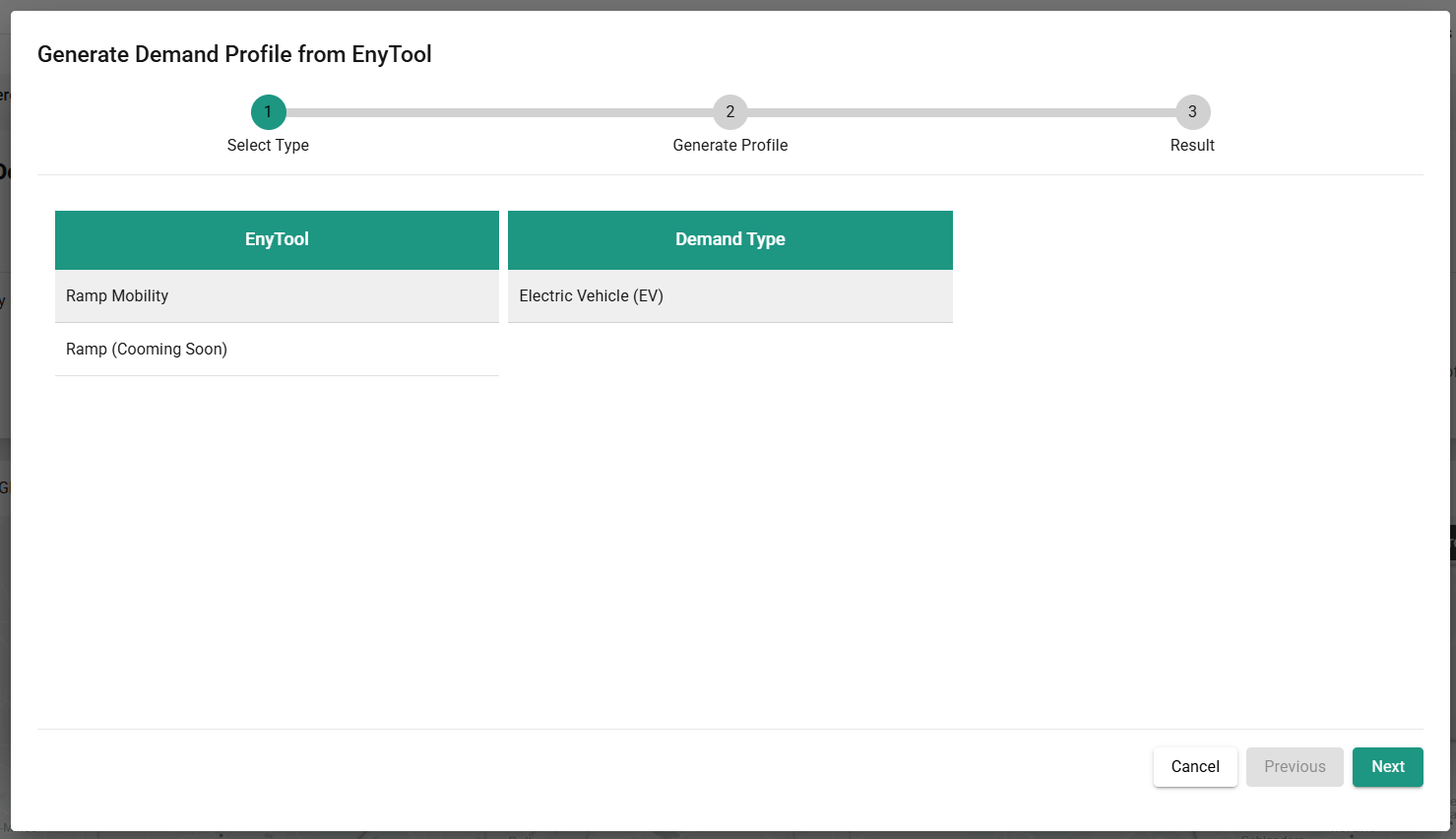
1. Select Ramp Mobility
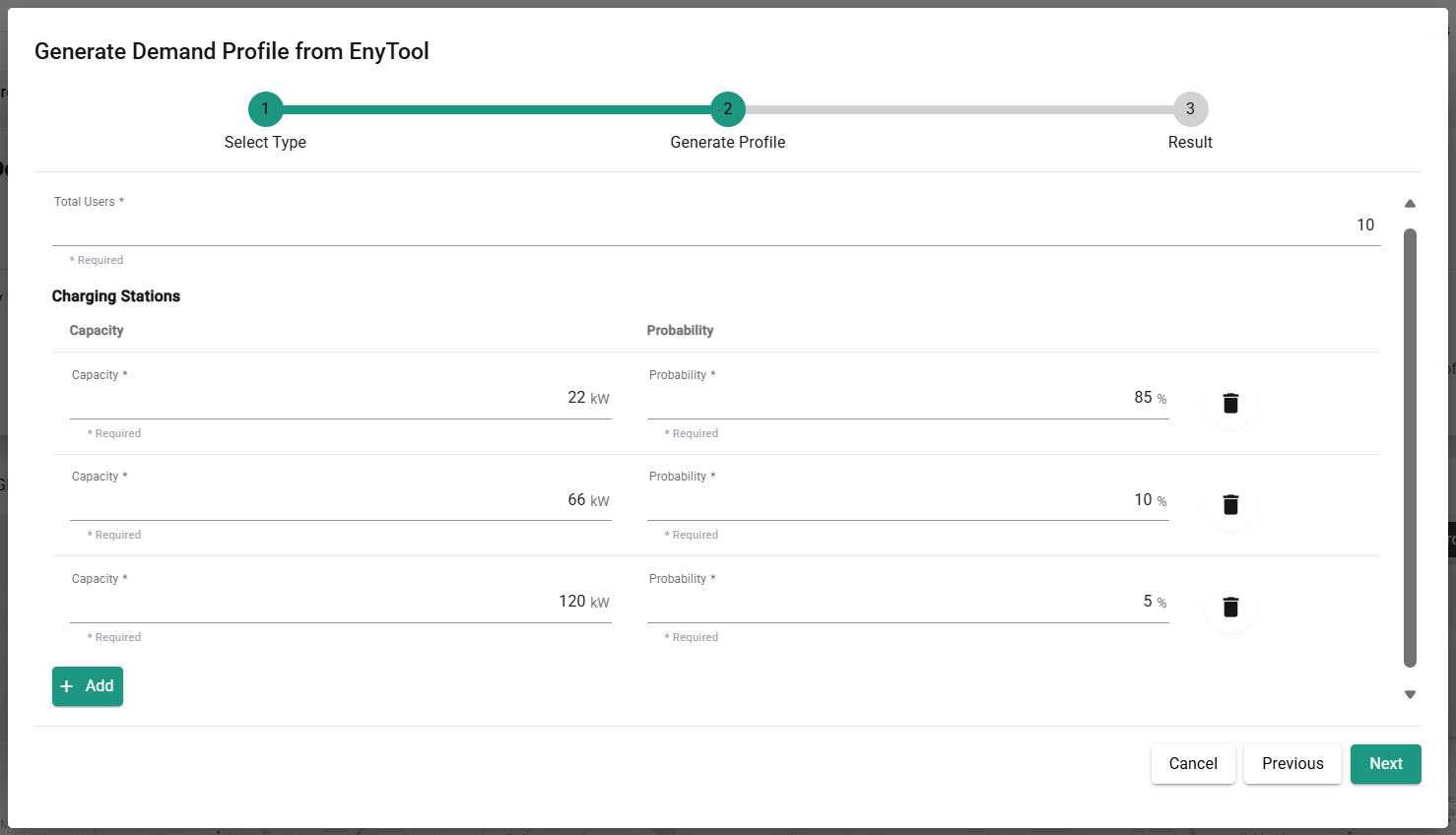
2. Add parameters, the probability should sum to 100%
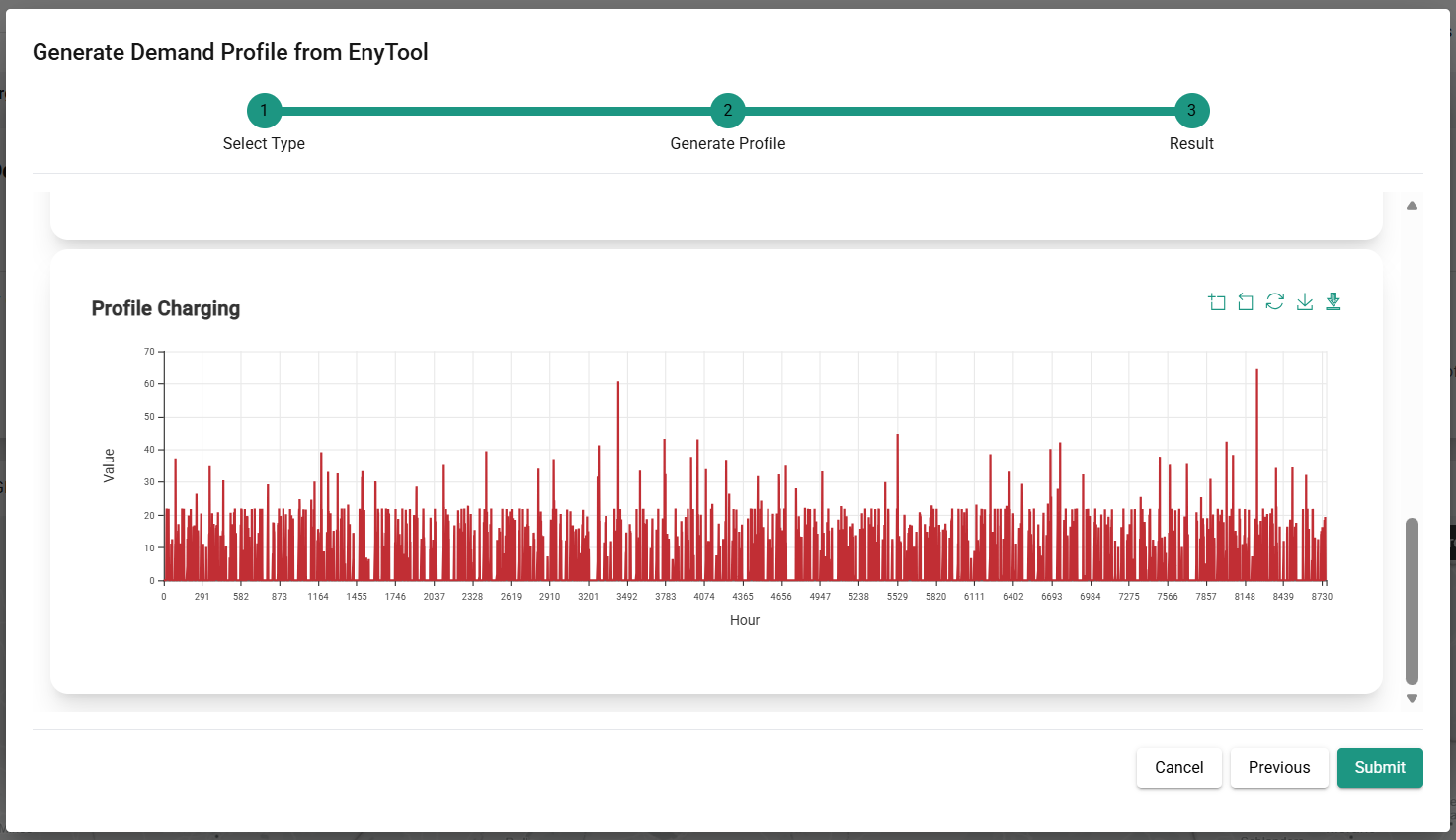
3. After a couple minutes, three profiles are generated.
Three profiles are available to download, before clicking submit:
-
The mobility profile in [W] is the energy used by all of the EV as they drive
-
The usage profile [number of EV] is the number of EV that are driving at any given time
-
The charging profile [kWh] is the electricity provided by all charging stations to the EV fleet
Click submit to add the Profile Charging as demand.
Reference:
The RAMP-mobility tool was developed in collaboration with: *A. Mangipinto, F. Lombardi, F. Sanvito, M. Pavičević, S. Quoilin, E. Colombo, Impact of mass-scale deployment of electric vehicles and benefits of smart charging across all European countries, Applied Enery, 2022, https://doi.org/10.1016/j.apenergy.2022.118676. *
Further reference: EMP-E presentation of RAMP-mobility: A. Mangipinto, F. Lombardi, F. Sanvito, S. Quoilin, M. Pavičević, E. Colombo, RAMP-mobility: time series of electric vehicle consumption and charging strategies for all European countries, EMP-E, 2020, https://doi.org/10.13140/RG.2.2.29560.26880
Publication of the original RAMP software engine: F. Lombardi, S. Balderrama, S. Quoilin, E. Colombo, Generating high-resolution multi-energy load profiles for remote areas with an open-source stochastic model, Energy, 2019, https://doi.org/10.1016/j.energy.2019.04.097.